

How Can You Save Money on Household Essentials?
Last Updated: November 4, 2026
Quick Summary
You save money on household essentials by buying generic store brands on simple staples, using cost-per-use math instead of shelf price, and buying in bulk only when unit price, storage space and consumption all line up. Build a list from an inventory check, track recurring expenses, and replace disposables you actually use with reusable items.
- Cost-per-use is the item price divided by the number of times you will actually use it.
- Compare unit prices by dividing pack price by the count, not the shelf price.
- Skip bulk when storage is tight, shelf life is short, or unit price is not lower.
- Photograph pantry and cleaning cupboard shelves once a quarter to avoid duplicate buys.
- Cancel any recurring subscription you have not used in two months.
Table of Contents
- Why Household Essentials Drain Your Budget
- How to Build a Household Essentials Shopping List
- Generic vs Name Brand Household Products: What to Buy Cheap
- Is Buying Household Essentials in Bulk Actually Cheaper?
- Where to Find Cheap Cleaning Supplies That Still Work
- Track What You Own Before You Buy Again
- Cut Utility and Disposable Costs Around the Home
- The Spending Habits That Quietly Cost You Money
- Build Your First Essentials Order at Loading Depot
- Frequently Asked Questions
Why Household Essentials Drain Your Budget
Most households do not overspend on big-ticket items. They overspend on the small, repeat purchases that never get audited: cleaning sprays, paper goods, storage bags, light bulbs, and the "just one more thing" additions to a weekly shop. This guide from Loading Depot breaks down how to save money on household essentials without turning your life into a spreadsheet project.
The pattern is predictable. Essentials feel non-negotiable, so they escape scrutiny. You compare prices on a laptop but grab the same detergent on autopilot. Over a year, that autopilot costs more than most people realize. The Consumer Financial Protection Bureau's household budgeting guidance makes a simple point worth repeating: tracking recurring expenses is the first step to controlling them.
The Cost-Per-Use Mindset
Cost-per-use is the price of an item divided by the number of times you will actually use it before it fails or runs out. A cheap sponge replaced every two weeks can cost more per use than a reusable item that lasts for months. Cheap upfront is not cheap over time.
This single shift in thinking reframes almost every purchase decision in your home. Ask what a thing costs per use, not what it costs on the shelf. A reusable item that survives a year usually beats a disposable one bought twelve times.
How to Build a Household Essentials Shopping List
Start with what you already own, not with what you want to buy. A household essentials shopping list built from an inventory check prevents duplicate purchases, which are the quietest waste in any home.
Here is the process we recommend:
- Walk your home room by room and note what is genuinely running low.
- Separate needs from restocks: cleaning supplies, paper goods, and storage are needs; decor and upgrades are not.
- Group the list by store section so you make one efficient trip.
- Add a "check before buying" column for anything you might already have in a cupboard.
- Set a rough ceiling for the trip and stop when you hit it.
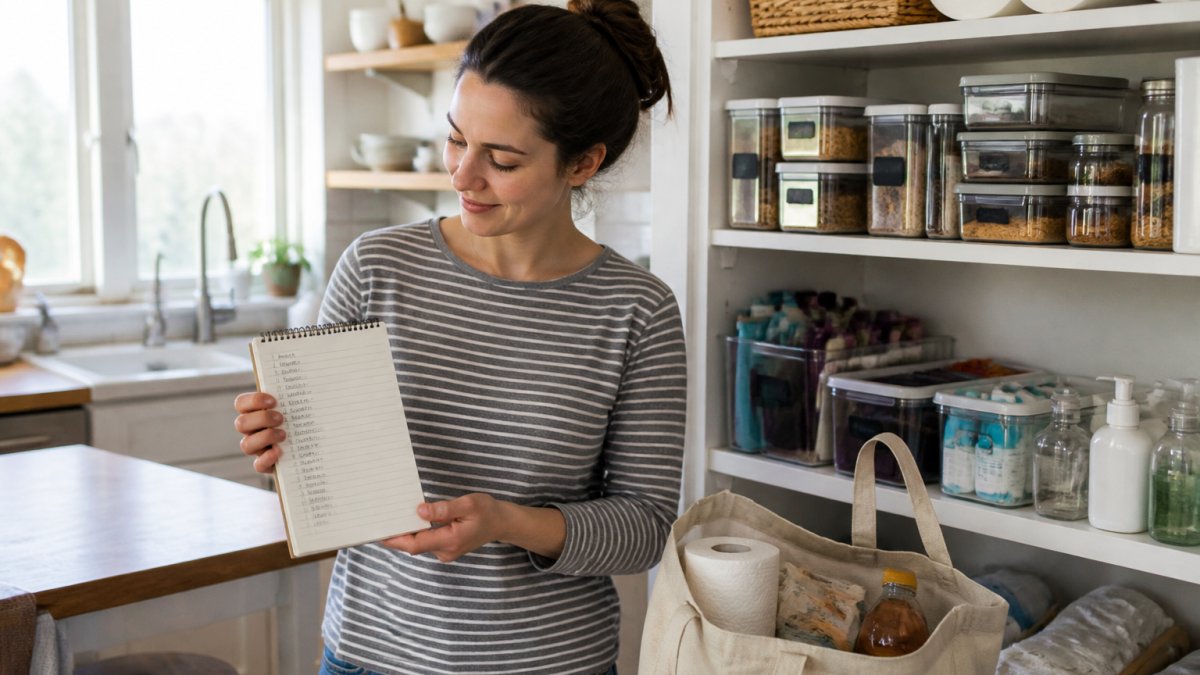
A list is not bureaucracy. It is the cheapest anti-impulse tool you own.
Generic vs Name Brand Household Products: What to Buy Cheap
Buy generic where the product is chemically or functionally simple, and pay for the name brand only where formulation genuinely matters. That is the short answer to the generic vs name brand household products question.
Store brands on basic staples such as cleaning supplies often serve the same purpose as branded equivalents. Where it pays to be picky: laundry detergent for sensitive skin, and anything applied directly to skin or ingested. For cleaning cloths, storage bags, and organizers, the material and construction matter far more than the label.
A common mistake is assuming the premium brand is always better. In practice, unit pricing on the shelf tag tells you more than the packaging does.
Is Buying Household Essentials in Bulk Actually Cheaper?
Bulk buying is cheaper only when three conditions hold at once: you have storage space that does not displace something else you need, you will use the item before it expires or degrades, and the per-unit price is genuinely lower than the smaller pack after accounting for any membership fee. Miss any one of those and bulk buying household essentials becomes a way to spend more, not less.
The mistake most shoppers make is comparing pack prices instead of unit prices. A 24-roll pack at $18 and a 12-roll pack at $10 look like the bigger pack wins, but the unit price is $0.75 per roll versus $0.83, a real saving. Flip the numbers and the "deal" disappears. Always divide the pack price by the count or weight printed on the label, and compare that number, not the shelf price.
The Break-Even Calculation
Before you commit to a bulk pack, run a simple break-even test:
- Unit price of the bulk pack = pack price ÷ number of units.
- Unit price of the small pack = pack price ÷ number of units.
- Monthly consumption = how many units your household actually uses in a month (check your inventory note from the previous section).
- Months to finish = bulk units ÷ monthly consumption.
- Break-even = the bulk pack only wins if the unit-price saving multiplied by the units you will realistically use exceeds any membership fee, storage cost, or spoilage loss.
If your inventory note says you use one bottle of dish soap every six weeks, a six-bottle bulk pack is a ten-month supply, fine if storage is free and the product does not degrade, wasteful if you move, change brands, or the formula separates.
What Bulk Buying Actually Works For
| Item Type | Bulk Worth It? | Why |
|---|---|---|
| Paper goods and cleaning cloths | Usually yes | Long shelf life, high turnover, no formulation risk |
| Cleaning concentrates | Yes | Diluted use stretches volume; concentrates store small |
| Laundry and dish detergent | Sometimes | Check for scent or enzyme degradation over 12+ months |
| Perishable or scented goods | Often no | Degrades before you finish it |
| Niche single-use items | No | Sits unused, ties up cash and shelf space |
The Storage Cost Nobody Counts
Bulk buying has a hidden cost: the square footage it occupies. A garage shelf, a closet, or a basement corner is not free, it is space you could use for something else. A useful rule of thumb is that if a bulk pack forces you to buy a shelving unit or rent storage, the saving is already gone. Keep bulk purchases to categories that fit on shelves you already own.
Watch out: warehouse-club membership fees only pay for themselves if your annual unit-price savings exceed the fee. Track one quarter of purchases against the same items at a regular store before renewing.
When Bulk Buying Is the Wrong Move
Skip bulk when the item is new to your household (you do not yet know if you will use it), when it has a short shelf life, when storage space is tight, or when the unit price is not actually lower. A larger box is not automatically the better deal, the shelf label's unit price is the only number that settles the question.
Where to Find Cheap Cleaning Supplies That Still Work
The trick is separating products that clean from products that only smell like they clean.
Reusable cleaning cloths are where most households overspend without noticing. Disposable wipes and sponges get replaced constantly. A reusable option changes the math. Our multi-pack heavy-duty mesh cleaning cloths are built for dishes, pans, sinks, and stovetops, and the set is reusable rather than single-use.

Save the specialized sprays for the surfaces that actually need them.
Multi-Pack Heavy‑duty mesh cleaning cloths for dishes pans sinks and stovetops →
Track What You Own Before You Buy Again
An inventory system is the gap most frugal-living guides skip entirely. Knowing what you own stops you rebuying items buried at the back of a cupboard, and it makes bulk buying safer because you can see what you actually consume.
A simple version works fine:
- Photograph your pantry and cleaning cupboard shelves once a quarter
- Keep a running note of items you have opened versus items in reserve
- Mark a "reorder point" on the items you use fastest
- Review the note before every shop, not after
This takes about fifteen minutes a quarter. It prevents the most common form of household waste: buying a third bottle of something you already have two of.
Cut Utility and Disposable Costs Around the Home
Utility bills and disposables are the two household expenses that respond fastest to small changes, because both are recurring and both are measurable. Neither requires a renovation budget, but both reward a cost-per-use mindset over a one-time price comparison.
Utilities: Where the Money Actually Goes
Most of a household utility bill sits in three places: heating and cooling, water heating, and always-on electronics. The practical moves are unglamorous but effective:
- Lighting. Swap the bulbs you use daily for LEDs. Replace only the fixtures you actually run, a bulb in a guest-room lamp that is on twice a year will not repay its price.
- Water heating. Lower the thermostat setting a few degrees and insulate the tank and the first stretch of pipe. The mechanism is simple: less energy is lost before the water reaches the tap.
- Standby draw. Chargers, set-top boxes, and small appliances draw power even when idle. A power strip that switches off the whole cluster at night is cheaper than unplugging each device by hand.
- Laundry and dishwashing. Run full loads rather than half loads, wash in cold water where the detergent allows, and clean the dryer lint filter every cycle, a clogged filter lengthens drying time and wastes heat.
A useful discipline is to read one utility bill line by line once a quarter and note which line moved. Most households find one or two lines account for most of the variance, and those are the ones worth attacking.
Disposables: Replace What You Actually Consume
On disposables, the rule is to replace only what you use most often with reusable equivalents. The math is cost-per-use: a reusable item that survives a year usually beats a disposable bought repeatedly, but a reusable item you rarely use is just spending with better intentions.
- Cleaning cloths and sponges. Disposable wipes and sponges get replaced constantly. A reusable cloth or mesh scouring pad changes the math because it is bought once and reused for months.
- Food storage. An insulated fresh-keeper bag keeps bananas, lettuce, and vegetables usable for longer, which directly reduces food waste, and food waste is one of the largest hidden line items in a household budget.
- Paper goods. Cloth napkins and microfiber cloths replace paper towels for most spills; keep paper on hand only for the jobs where cloth genuinely will not do.
Watch out: buying reusable alternatives for items you rarely use is not saving, it is just spending with better intentions. Replace only what you actually consume regularly, and check your inventory note before buying a second reusable version of something you already own.
The Eco-Frugality Overlap
Waste reduction and cost reduction are usually the same action. Buy less, reuse more, and both your spending and your bin benefit. The reason is mechanical, not moral: every disposable you stop buying is a recurring cost removed, and every item you keep in service longer is a purchase deferred. That is why the greenest habits, cloth rags, DIY cleaners from vinegar and baking soda, full loads, LED bulbs, are also the frugal ones. The intersection is the most reliable place to find savings that stick, because the habit reinforces itself: you see the lower bill and the emptier bin at the same time.
The Spending Habits That Quietly Cost You Money
The psychology of spending matters more than any coupon here. Impulse purchases at the checkout, "stocking up" during sales you did not plan for, and subscription services that renew unnoticed all drain a household budget without ever appearing as a decision.
Three habits to audit this month:
- The checkout add-on. Small impulse purchases near the till add up faster than any single large buy.
- The forgotten subscription. List every recurring charge and cancel anything you have not used in two months.
- The sale trap. A discount on something you did not need is still money spent, not money saved.
Price comparison and price matching help, but only after you have decided you need the item. Consumer habits, not coupon clipping, decide most household budgets. The Federal Trade Commission's consumer advice on saving money puts the emphasis where it belongs: on planning spending rather than reacting to offers.
There is an eco-frugality angle here worth naming. Waste reduction and cost reduction are usually the same action. Buy less, reuse more, and both your spending and your bin benefit.
Build Your First Essentials Order at Loading Depot
The final step is putting the system into practice with one consolidated order rather than five scattered trips. That is where a one-stop shop earns its place: fewer journeys, fewer impulse stops, and a clearer view of what you actually spent.
At Loading Depot, we stock everyday essentials for the home, office, and auto in one place, with a growing selection of useful products and a convenient shopping experience. If you are outfitting a first apartment or restocking a family home, start with the reusable items that replace recurring costs: cleaning cloths and storage bags.
Frequently Asked Questions
What is the best way to save money on household items?
Start with a written list and a monthly cap for essentials, then compare unit prices rather than pack prices. Buy store brands for staples like cleaning spray and foil, and name brands only where performance clearly differs. Track what you already own so you stop rebuying duplicates. Reusable items, such as a multi-pack of heavy-duty mesh cleaning cloths at $14.99, can replace repeat purchases of disposable wipes.
Is it cheaper to buy household essentials in bulk?
Often, but only for items you will actually use before they expire or spoil. Bulk buying works best for non-perishables with long shelf lives, like cleaning concentrate, laundry detergent, and paper goods. It backfires on products you use slowly or have nowhere to store. Check the unit price on the shelf label, confirm you have space, and skip bulk sizes of anything you are still testing for the first time.
Which household essentials should I buy generic?
Generic and store-brand products are often a practical choice for many everyday household items. The gap tends to show up in products where formulation matters, such as stain treatments or specialty adhesives. For most routine cleaning, a cheap cleaning supply refill does the same job. Compare the active ingredients on the label before you decide the brand version is worth the extra cost.
How do I make a budget for household supplies?
Review three months of receipts or bank statements and total what you actually spent on cleaning, paper goods, toiletries, and organization. Divide by three for a realistic monthly baseline, then set a target slightly below it. Split the number into consumables and one-off purchases so a new storage bin does not eat your cleaning budget. Review the total each month and adjust rather than guessing at the start.
How can I tell whether a household essentials deal is actually good value?
Ignore the percentage-off sticker and calculate cost per use or cost per unit. A larger pack at a higher price can still be cheaper per wash, per sheet, or per litre. Factor in how long the item lasts: a reusable silicone air fryer liner at $10.99 helps protect the air fryer from food residues. If you cannot work out the per-use cost, the deal is not verifiable yet.
How can I spend less on household essentials without buying lower quality?
Buy the right quantity, not the cheapest version. Use a shopping list to avoid impulse purchases, buy store brands where the formulation is identical, and choose reusable items for jobs you do daily. A complete sewing kit at $31.99 is designed for sewing and embroidery work on a variety of garments and home textiles. Quality usually comes from buying the correct item once rather than the cheapest item repeatedly.
Your household essentials budget will not fix itself through willpower. It fixes through a list, a cost-per-use check, and a habit of buying reusable where disposable is costing you every month. Get started with Loading Depot and build one essentials order that covers your home, office, and auto needs in a single, convenient stop.
